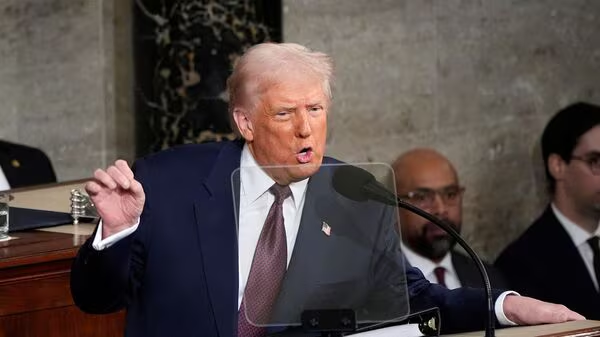
Trump’s Strategic Crypto Reserve: A Game-Changer for the U.S. and the Global Market
A Bold Shift in U.S. Crypto Policy
On March 5, 2025, President Donald Trump made headlines when he announced plans to establish a “Strategic Crypto Reserve,” a bold initiative that includes five major cryptocurrencies: Bitcoin, Ethereum, Solana, XRP, and Cardano. This new reserve, capitalized by Bitcoin owned by the U.S. Treasury Department through asset forfeitures, represents a significant pivot in how the U.S. views digital assets. The creation of this reserve marks a departure from previous administrations’ more cautious stance on cryptocurrencies and could signal a new era of crypto-friendly policy in the United States.
Trump’s executive order, signed on March 7, officially established the “Strategic Bitcoin Reserve” and a separate “U.S. Digital Asset Stockpile” for other cryptocurrencies. While the initiative has sparked strong reactions in the market, many industry experts believe its long-term implications could be far-reaching.
As the White House prepares for its first-ever crypto summit, the focus will be on refining the details of the plan and addressing concerns from the crypto industry. This article explores the significance of Trump’s crypto reserve, its potential market impact, and what it means for the future of digital assets.
The Strategic Crypto Reserve: A Major Policy Shift
What’s Involved in Trump’s Crypto Reserve?
Trump’s executive order establishes two key components for U.S. digital asset policy:
-
Strategic Bitcoin Reserve: This reserve will be primarily capitalized by Bitcoin obtained through asset forfeitures. The U.S. government has accumulated around 200,000 Bitcoin through civil and criminal actions, and these holdings will form the foundation of the reserve. The goal is to preserve and grow these assets without using taxpayer money.
-
U.S. Digital Asset Stockpile: Unlike the Bitcoin-focused reserve, this stockpile will include other cryptocurrencies, such as Ethereum, Solana, XRP, and Cardano, which will also be obtained through law enforcement asset forfeitures. This diversified reserve aims to position the U.S. as a major player in the global digital asset market.
Trump’s plan also includes creating a framework for managing these assets with an emphasis on long-term preservation and “responsible stewardship.” The administration aims to conduct a full audit of the existing crypto holdings to assess their value and potential for future growth.
Market Reaction: Initial Enthusiasm Follows by Caution
Following Trump’s announcement, the crypto market initially reacted with strong enthusiasm. Bitcoin prices surged, and many market participants saw this as a bullish move that would further legitimize the sector. However, as the details of the plan became clearer, a degree of caution set in.
Several prominent figures in the crypto industry, including Coinbase CEO Brian Armstrong and Castle Island’s Nic Carter, voiced concerns about the inclusion of non-Bitcoin assets in the reserve. While some believed a Bitcoin-only reserve would be a more straightforward approach, others, like Matt Hougan, Chief Investment Officer of Bitwise, argue that the proposal has broadened the scope of what a U.S. crypto reserve could be.
The Future of the Reserve: A Work in Progress
Hougan has suggested that the initial proposal, while ambitious, is still evolving. He sees the current market reaction as a misreading of the reserve’s long-term significance. “Several crypto luminaries have raised questions about the reserve and the inclusion of non-Bitcoin assets. But I think the boldness of the initial proposal has widened the Overton window for what the reserve can be,” he explained.
As industry leaders gather at the White House crypto summit, this discussion is expected to continue. The summit will likely play a crucial role in shaping the final version of the reserve and refining the strategy for how it will be implemented.
The Global Ripple Effect: What This Means for Other Nations
U.S. Leadership in the Global Crypto Market
Trump’s decision to create a Strategic Crypto Reserve has potential implications beyond the borders of the United States. If other countries, especially in Latin America, follow the U.S. example, we could see a global shift in how cryptocurrencies are treated on the national stage.
Countries like El Salvador, which recently adopted Bitcoin as legal tender, have already taken steps toward embracing digital assets. With the U.S. now moving to acquire Bitcoin and other cryptocurrencies on a national scale, nations such as Honduras, Mexico, and Guatemala may feel pressure to follow suit. As Hougan pointed out, “If you are Honduras, Mexico, or Guatemala, and you’re watching El Salvador and now the U.S. acquire Bitcoin, can you really afford to be at zero?”
This development could create a competitive dynamic where other countries are compelled to build their own reserves to stay relevant in the emerging digital economy. As the U.S. establishes its crypto reserves, it will likely set a global precedent for how digital assets are perceived by governments.
The Future of U.S. Political Support for Crypto
While the details of Trump’s crypto reserve plan are still being hashed out, Hougan believes that one of the most important takeaways is the “asymmetric passion” for crypto in American politics. He predicts that future administrations, regardless of political affiliation, will be unlikely to reverse these efforts due to the growing bipartisan support for crypto. “Democratic leaders won’t want to alienate voters at little benefit to themselves,” Hougan said.
This broad support for crypto could mean that, even with changes in administration, the U.S. will continue to adopt policies that promote the growth of digital assets. The U.S. government’s decision to label cryptocurrencies as “strategic” assets is a clear signal that the country is preparing to embrace the future of finance.
What’s Next: Key Takeaways from the White House Crypto Summit
The White House’s crypto summit is set to be a pivotal moment in the evolution of U.S. crypto policy. With key industry leaders present, the summit will provide a platform for discussing the details of Trump’s crypto reserve and for pushing forward with regulatory changes that support innovation in the digital asset space.
During the summit, it is expected that discussions will focus on:
- Refining the Reserve: How to address concerns about including non-Bitcoin assets in the reserve and ensuring it aligns with broader market goals.
- Stablecoin Legislation: Supporting stablecoin regulation as part of a comprehensive approach to digital asset regulation.
- Global Implications: Understanding how the U.S. reserve affects global markets and other countries’ crypto strategies.
The outcome of these discussions will likely shape U.S. crypto policy for years to come, solidifying the country’s position as a global leader in the digital asset space.
A Bold Move for a Digital Future
Trump’s announcement of the Strategic Crypto Reserve is one of the most significant moves in U.S. digital asset policy in recent years. By establishing a reserve for Bitcoin and other cryptocurrencies, the U.S. government has signaled that it is fully committed to embracing the future of digital finance.
While the initial market reaction has been mixed, the long-term implications of the reserve are clear: The U.S. is preparing to take a leadership role in the global crypto economy. With continued support from industry leaders and further refinements to the plan, this initiative could set the stage for the next chapter in the evolution of digital assets.
Disclaimer: The above press release has been provided by a third party. We do not verify or endorse the content and will not be responsible for any inaccuracies, claims, or damages arising from the same.