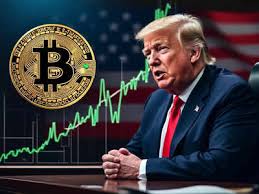
Trump’s $1M Bitcoin Bet? U.S. Strategic Reserve Could Send BTC to the Moon
Could the U.S. Buying 1 Million Bitcoins Send BTC to $1 Million?
A radical shift in U.S. economic strategy could catapult Bitcoin to $1 million—if Washington executes on a bold new vision. The idea? Accumulate 1 million BTC without raising taxes.
That’s the forecast emerging from a provocative conversation hosted by Bitcoin Magazine, featuring Zach Shapiro and Matthew Pines of the Bitcoin Policy Institute (BPI). Their message: If the U.S. government declares a serious bid to dominate Bitcoin reserves, the global market will react in seismic fashion—and Bitcoin’s price could rocket to $1 million faster than anyone expects.
The Strategic Bitcoin Reserve: A New Economic Doctrine
Trump’s Executive Order Signals a New Digital Playbook
On March 7, 2025, President Donald Trump signed a historic executive order establishing the Strategic Bitcoin Reserve and Digital Asset Stockpile—two groundbreaking initiatives aimed at putting the United States on a direct path to Bitcoin leadership.
Rather than relying on taxpayer dollars, the executive order calls for alternative revenue streams to fund Bitcoin accumulation. The directive instructed the Treasury and Commerce Departments to develop acquisition methods that do not increase the federal budget.
According to Zach Shapiro, Head of Policy at the Bitcoin Policy Institute:
“If the United States announces that we are buying a million Bitcoin, that’s just a global seismic shock. […] I think we’d probably go very quickly to something like a million dollars per Bitcoin.”
U.S. Bitcoin Accumulation Strategy: Budget-Neutral and Bold
How to Buy 1 Million BTC Without Raising Taxes
Matthew Pines, Executive Director at BPI, elaborated on a variety of non-tax-based funding sources that could be deployed to accumulate a strategic Bitcoin reserve:
-
Tariff revenues
-
Oil and gas royalties
-
Sales of federal land
-
Physical gold liquidation
-
Profits from other digital asset holdings
These strategies allow the government to diversify its asset reserves while maintaining budget neutrality. They also align with Trump’s broader goal of economic nationalism and self-reliance.
“This is a measure of how much the United States is making good on that rhetorical objective,” said Pines, referring to Trump’s promise to make America a “Bitcoin superpower.”
Tariffs Take Center Stage: April Order Reinforces Funding Vision
Just weeks after the Strategic Bitcoin Reserve was announced, Trump doubled down with another executive order on April 2, 2025, imposing a 10% baseline tariff on all imports and introducing reciprocal tariffs against nations that tax U.S. goods.
This move is not just about trade—it’s also a revenue generation mechanism. The administration has explicitly linked tariff proceeds to the funding of Bitcoin acquisitions.
“Tariff revenue can be a strategic financial lever,” Pines explained. “It supports domestic industry and provides non-tax income streams for digital asset stockpiling.”
Legislation Backing the Strategy: The BITCOIN Act Returns
On March 12, Senator Cynthia Lummis reintroduced the BITCOIN Act—formally known as the Boosting Innovation, Technology, and Competitiveness through Optimized Investment Nationwide Act.
The bill aims to formalize and expand the U.S. government’s Bitcoin reserves beyond 1 million coins, institutionalizing digital assets as a pillar of national financial strategy.
Lummis has long been one of Capitol Hill’s most vocal advocates for Bitcoin. The reintroduction of the bill signals legislative alignment with the White House’s agenda, making Bitcoin accumulation not just a financial move—but a strategic imperative.
Geopolitical Implications: The Race to Accumulate Bitcoin
A Global Arms Race—But in Digital Gold
According to BPI, other governments are closely monitoring America’s actions. The implications of the U.S. holding 1 million BTC—approximately 5% of total supply—could set off international accumulation strategies in response.
This may trigger a global Bitcoin arms race, where nation-states move to protect their monetary sovereignty by hedging against inflation, sanctions, and dollar dependency using Bitcoin.
Bitcoin, long considered an insurgent asset, could morph into a state-level reserve currency alternative.
“If America leads, others will follow—out of fear or necessity,” said Pines.
Market Impact: Could Bitcoin Really Hit $1 Million?
The Supply Shock Scenario
Bitcoin is capped at 21 million coins, and an estimated 3-4 million are lost forever. If the U.S. buys 1 million BTC, that’s a massive chunk of remaining circulating supply—an act that could:
-
Spark global FOMO among retail and institutional investors
-
Force price discovery into uncharted territory
-
Create long-term supply scarcity, driving exponential value gains
With Bitcoin trading at $84,352 at the time of BPI’s comments, a move to $1 million would represent a 12x surge—not impossible in a supply shock environment amplified by nation-state-level demand.
The Bigger Picture: Bitcoin as a Strategic Asset
This isn’t just about Bitcoin price targets. The United States is laying the groundwork for a new era of sovereign digital asset accumulation.
The narrative is shifting from:
-
“Should governments own Bitcoin?”
To: -
“How much Bitcoin should governments own?”
This paradigm shift redefines Bitcoin from a speculative play to a strategic reserve asset, akin to gold or oil in past geopolitical eras.
A Digital Manifest Destiny?
With executive orders, legislation, and think tanks aligned around the concept of a Bitcoin-powered future, the United States may be entering a new economic era—one where digital assets underpin global influence.
While the $1 million BTC price point may sound dramatic, the math behind the scarcity mechanics and demand curves makes the thesis worth watching—especially if other countries begin to mirror the U.S. playbook.
For now, investors and policy observers alike will be watching the next moves out of Washington—and whether the world’s largest economy will go all-in on digital gold.
Disclaimer: The above press release has been provided by a third party. We do not verify or endorse the content and will not be responsible for any inaccuracies, claims, or damages arising from the same.