
Bitcoin Drops to $82,000 After Trump’s Tariff Announcement: Experts Say It’s a Prime Buying Opportunity
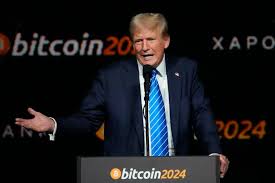
The cryptocurrency market experienced significant turbulence following President Donald Trump’s April 2 announcement of sweeping tariffs. While traditional financial markets braced for impact, Bitcoin saw a sharp drop in price, falling from a brief surge to $88,000 to a low of $82,000. As the volatility continues, some analysts are suggesting this may be a prime buying opportunity for investors looking to capitalize on Bitcoin’s potential long-term growth.
Trump’s Tariff Announcement Shakes Global Markets
The announcement from President Trump that new tariffs would be placed on global imports set off waves of panic through both stock markets and digital assets. In a sweeping 45-minute address, Trump unveiled a 10% baseline tariff on all goods entering the U.S., with higher rates set for countries like China (34%) and the European Union (20%). Additionally, a 25% tariff was placed on automotive imports.
The news triggered a sell-off in U.S. stocks, with major indices like the S&P 500 losing more than $2 trillion in market capitalization. But the impact wasn’t limited to traditional assets—Bitcoin, which was initially buoyed by rumors of a delay in tariffs, experienced rapid fluctuations. The cryptocurrency briefly surged to $88,000 before quickly dropping to $82,000, signaling both uncertainty and opportunity for investors in the digital asset space.
Bitcoin Volatility: A Sign of Market Strength?
Despite the steep price movements, some analysts see the volatility as a sign of market strength rather than weakness. According to Valentin Fournier, Lead Analyst at BRN, the market’s immediate response to the tariff announcement was a natural reaction to uncertainty. Fournier stated, “With speculation now largely resolved, institutional investors will feel more comfortable re-entering the market, which could drive Bitcoin’s price back toward $90,000 in the coming weeks.”
Similarly, David Hernandez, a Crypto Investment Specialist at 21Shares, emphasized that while the tariff rates were slightly higher than expected, the clarity of the announcement might act as a stabilizing force. “This new clarity could encourage institutional investment, providing a much-needed boost to the cryptocurrency market.”
The growing demand for Bitcoin Exchange-Traded Funds (ETFs) supports this sentiment. BlackRock’s Bitcoin ETF, in particular, saw a surge of $218 million in inflows on April 2, reversing $157 million in net outflows the previous day. This suggests that institutional investors remain interested in Bitcoin, even amidst short-term volatility.
Altcoins Struggle: Ethereum and Solana See Major Declines
While Bitcoin has seen some recovery, other cryptocurrencies, notably Ethereum and Solana, have faced greater challenges. Ethereum has seen continuous outflows, with its price remaining more than 55% below its cycle high. Analysts attribute Ethereum’s struggles to persistent investor skepticism and the lack of clear bullish catalysts within the altcoin market.
Solana, which had gained significant attention earlier in the year, also took a hit following the tariff announcement. The Solana token experienced a decline of over 6% and continues to languish at multi-month lows. In contrast, Bitcoin’s relative stability—despite its fluctuations—has positioned it as the preferred cryptocurrency for many institutional investors and traders.
Institutional Interest: A Silver Lining Amidst the Chaos
Despite short-term volatility, analysts are increasingly confident that institutional interest in Bitcoin could be the key to its long-term growth. Kraken’s Global Economist, Thomas Perfumo, pushed back against the notion that institutional investors could eliminate market cycles. Perfumo acknowledged that Bitcoin’s price will continue to experience fluctuations but suggested that these fluctuations reflect a strong demand for a scarce asset. “Mainstream adoption of Bitcoin will not follow a linear path,” Perfumo explained, “and volatility is part of the process.”
This opinion is echoed by analysts who have described the sell-off in Bitcoin as an overreaction. They argue that the tariff news, while impactful, is ultimately a reflection of the uncertainty surrounding U.S. trade policy. Bitcoin, often compared to gold as a store of value, continues to attract investors seeking stability amid economic uncertainty.
Is Bitcoin’s Price Decline a Buying Opportunity?
Many investors are wondering if now is the right time to buy Bitcoin at a discount. With the price dropping to $82,000, analysts are divided on whether this signals the start of a deeper downturn or a potential buying opportunity.
Some see the recent decline as a chance to enter the market at a more favorable price, predicting that Bitcoin’s price could eventually rebound to new highs. According to Fournier, “Bitcoin’s price is still fundamentally strong, and the long-term bullish trend remains intact. Investors who buy during these price dips could benefit when the market stabilizes.”
On the other hand, some market participants remain cautious, awaiting further developments on the global economic front, including the full impact of President Trump’s tariffs and their long-term effects on cryptocurrency markets. For now, Bitcoin’s price remains volatile, with a potential for both upside and downside in the coming weeks.
Looking Ahead: What’s Next for Bitcoin?
As we look toward the future of Bitcoin and the broader cryptocurrency market, several key factors will influence its price action:
Institutional Investment: A Major Driver of Growth
Bitcoin’s ETF inflows indicate that institutional investors remain interested in Bitcoin as a store of value. With BlackRock and other major firms continuing to invest in Bitcoin, institutional demand could provide a solid foundation for future growth, especially once the market finds more stability.
Global Economic Policies: Potential for Continued Volatility
The potential impact of tariffs and other economic policies remains a wildcard. While some analysts believe that the clarity of Trump’s tariff announcement will help stabilize the market, others worry that further trade tensions could exacerbate global economic uncertainty, causing more fluctuations in the crypto market.
Adoption and Regulation: Bitcoin’s Path to Maturity
Ultimately, Bitcoin’s long-term success will depend on widespread adoption and the regulatory framework surrounding digital assets. If governments and financial institutions can provide a more stable regulatory environment, Bitcoin’s price could rise significantly as it becomes more widely accepted.
Is Now the Time to Buy Bitcoin?
For investors wondering if Bitcoin’s recent decline to $82,000 is a buying opportunity, the answer is likely yes—but with caution. The long-term outlook for Bitcoin remains strong, especially as institutional investors continue to show interest. However, market volatility is likely to persist in the short term, and Bitcoin’s price could fluctuate as the global economy adjusts to new policies and trade tensions.
As always, it’s important for investors to stay informed and consider a diversified investment strategy. While Bitcoin remains one of the most promising assets in the cryptocurrency space, it’s essential to understand the risks involved and be prepared for further market fluctuations.
Disclaimer: The above press release has been provided by a third party. We do not verify or endorse the content and will not be responsible for any inaccuracies, claims, or damages arising from the same.


More Stories
BIGBULL Capital Strengthens AI Router Protocol’s Push for Seamless Multi-Chain Interoperability
AI Router Protocol, a next-generation DePIN and AI-powered cross-chain routing platform, has secured a strategic investment from BIGBULL Capital, reinforcing...
BIGBULL Capital Strengthens AI Router Protocol’s Push for Seamless Multi-Chain Interoperability
AI Router Protocol, a next-generation DePIN and AI-powered cross-chain routing platform, has secured a strategic investment from BIGBULL Capital, reinforcing...
BIGBULL Capital Strengthens AI Router Protocol’s Push for Seamless Multi-Chain Interoperability
AI Router Protocol, a next-generation DePIN and AI-powered cross-chain routing platform, has secured a strategic investment from BIGBULL Capital, reinforcing...
BIGBULL Capital Strengthens AI Router Protocol’s Push for Seamless Multi-Chain Interoperability
AI Router Protocol, a next-generation DePIN and AI-powered cross-chain routing platform, has secured a strategic investment from BIGBULL Capital, reinforcing...
Winklevoss Slams SEC Despite Closure of Gemini Investigation: A Blow to Crypto Innovation?
A Lengthy Investigation, No Charges, But Big Costs for Gemini In a recent development that has sparked considerable debate within...
Bullish Crypto Bets Lose $1.2B as Bitcoin Fumbles to Under $89K, XRP Down 14%
Crypto Bulls Bleed $1.2B in 24 Hours as Bitcoin Dips Below $89K and XRP Crashes 14% In a stunning reversal...